PADI vs SSI Instructor Course: Cost, Structure, Hidden Fees & Career Outlook
If you are comparing a PADI vs SSI instructor course, the first thing to understand is this: both are valid pathways to becoming a working scuba instructor.
This is not a case of one agency being “real” and the other somehow not counting or non-viable. The better question is which system fits your goals, your budget, and the region where you actually want to work. That matters more than the usual brand mythology. In some markets, PADI is still the clearer employment path. In others, SSI is equally strong or stronger. The point of this guide is to compare the practical differences so you can make that decision properly and get a deeper understanding of the PADI IDC vs SSI ITC.
At instructor level, the comparison becomes more detailed than it is at Divemaster level. You are no longer just choosing an entry-level professional card. You are entering a professional system with its own course structure, evaluation model, annual renewals, digital tools, professional expectations, and crossover friction. That is why this comparison matters.
This article focuses specifically on the PADI vs SSI instructor course comparison. If you are still choosing between training centres, locations, course structure, and instructor trainers, start with our guide on how to choose the best dive instructor course in Bali.
Agency snapshot: PADI IDC vs SSI ITC at a glance
The simplest way to frame this is: PADI is the legacy market leader; SSI is the major global challenger with strong momentum.
PADI remains the best-known brand in recreational scuba and publicly says it has certified more than 30 million divers worldwide. SSI, however, is not some niche alternative anymore. SSI operates in 150+ countries, has 4,000+ training centers, and 100,000+ dive professionals globally. That means this comparison is no longer “big brand vs small alternative.” It is a comparison between two major global diving systems.
PADI’s strength is still brand recognition and entrenched market position. SSI’s strength is that it has become a large, modern, digitally integrated competitor with a much stronger value proposition than many people assume. SSI also has a clearly documented growth story: it was acquired by HEAD Sports in 2014, went fully digital in 2015, and launched the MySSI app and digital logbook in 2016.
The most common mistake is simple: people do very little real research.
They see the shops that market themselves best, compare some surface-level details, and assume they have seen the field. In reality, they often have not. They are comparing only the most visible programs, not necessarily the strongest ones.
Quick snapshot
Comparison Point | PADI IDC | SSI ITC |
|---|---|---|
Overall position | Legacy market leader | Major global competitor with strong momentum |
Brand recognition | Very strong | Strong and growing |
Teaching system feel | More fixed and standardized | More flexible and adaptive |
Public standards transparency | Limited to none | Openly available to the public and students |
Digital ecosystem | Improving, but less open to public review | One of SSI’s strongest advantages |
Typical user-facing price | Often looks cheaper at first glace than it really is (tends to omit many hidden add-on fees) | Often marketed much closer to the actual total cost |
Best fit | Legacy-heavy markets and PADI-dominant regions | SSI-heavy, mixed, and value-conscious markets. |
Teaching System, Digital Tools & Instructor Experience
This is where the comparison starts to matter more than many people expect.
In broad terms, PADI is solid but rigid, while SSI is more adaptive and digitally supportive. Structurally, both systems produce good instructors and good divers. The bigger difference is how the systems feel to teach within once you are actually working. In my view, SSI is more human-centered in delivery. PADI is more prescriptive. That is not automatically bad. A rigid framework can feel simple and reassuring, especially to new instructors. But in the real world, students do not always learn in a neat sequence and environmental conditions do not always cooperate with your planned evaluations.
That is where flexibility starts to matter.
SSI’s own standards explicitly state that SSI Professionals must follow the Total Teaching System, but may develop their own teaching style and program schedules, including the order and number of classroom and confined-water sessions, and the order of skills in confined water and open water. The same standards also note that if conditions and student ability permit, required skills may be evaluated during any open-water training dive. That is a meaningful difference in philosophy.
SSI also has the stronger publicly visible digital ecosystem. Through MySSI, students can access materials in multiple languages, complete digital learning, log dives, manage affiliations, download standards and instructor materials, and use the app as an integrated training and profile system. SSI’s own history materials explicitly frame digital rollout as part of its growth and modernization.
What this means in practice is that with the SSI system, all the course readings, exams, and even instructor materials/powerpoint presentations are available in over 40 languages. This means that you don’t need to order new printed material for every language, and you can teach or administer courses and exams in whatever preferred language easily and for free.
Transparency Note
Unlike SSI, where current training standards can be reviewed online or through a free MySSI account, PADI’s full current standards are not openly accessible for general public review. They are primarily distributed through professional resources such as the Instructor Manual, Guide to Teaching, Pro site tools, and Training Bulletins. That creates a real transparency gap for candidates trying to compare systems before they commit, or for students who are participating in the courses.
That matters. If you are joining a professional organization, you should ideally be able to inspect how it actually works.
Instructor Course Prerequisites: PADI IDC vs SSI ITC Entry Requirements
The good news is that the routes are broadly similar in seriousness. Neither one is a shortcut. Both expect a candidate who is already functioning at Divemaster level or equivalent.
SSI’s current Instructor Training Course standards show that candidates must be at least 18, hold Divemaster and Enriched Air Nitrox 40 or equivalent, have at least 60 logged dives to start the ITC, 100 logged dives to complete the OWI/IE stage, and have been certified as an Open Water Diver or higher for at least six months. SSI also requires professional candidates to upload proof of CPR, first aid, and oxygen first aid training within two years before final certification.
PADI store publicly states that a Divemaster who has been a certified diver for six months may enroll in the IDC, needs at least 60 logged dives and 100 dives to attend an IE, must have recent EFR Primary and Secondary Care training within 24 months, and must also become an Emergency First Response Instructor, which can be completed during instructor training at additional cost.
If you are still choosing where to complete your Divemaster, read our guide on how to choose the best Divemaster course in Bali before committing to an instructor pathway.
Prerequisites at a glance
Requirement | PADI IDC | SSI ITC |
|---|---|---|
Minimum age | 18 | 18 |
Minimum dives to start | 60 | 60 |
Minimum dives to certify / attend IE | 100 | 100 |
Active Divemaster required | Yes | Yes |
Nitrox required | Yes, Nitrox 40 or equivalent | Yes, Nitrox 40 or equivalent |
Six months since original Open Water certification | Yes | Yes |
Recent first-aid / CPR documentation | Yes | Yes |
First-aid Instructor requirement | EFR Instructor required | React Right Instructor not required |
Footnote: In practice, EFR Instructor is often not done as a standalone prerequisite beforehand for PADI IDCs. It is commonly bundled into the IDC pathway at additional add-on cost, which is exactly why candidates miss it when comparing headline pricing.
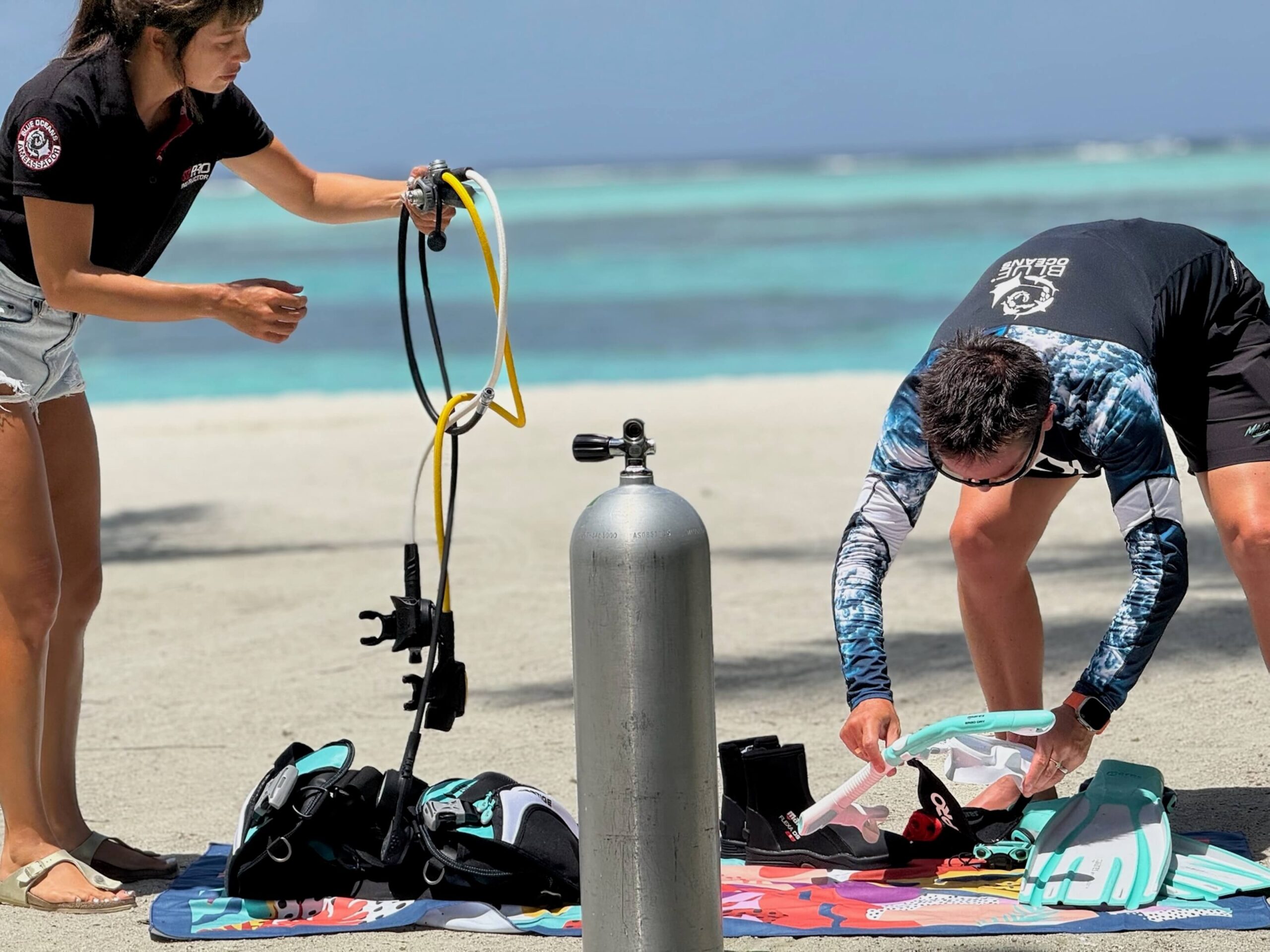
CPR / First Aid Instructor Expectations: EFR Instructor vs React Right Instructor
This is one of the first major places where hidden add-on costs show up.
PADI is straightforward here: to become a PADI Instructor, you also need to be an Emergency First Response Instructor, and PADI says you can bundle that certification during instructor training. That means it is functionally part of the full cost of becoming a PADI Instructor, even if it is usually left out of the advertised PADI IDC price.
SSI is different. SSI publicly lists React Right Instructor as a separate specialty instructor rating. SSI also requires current CPR, first aid, and oxygen first aid documentation for professional candidates, but React Right Instructor itself is not packaged in the same mandatory way as EFR Instructor is for the core instructor certification route.
That difference matters to the user because it affects the real total cost.
A practical benchmark from the market comparison in this article puts the EFR Instructor add-on at about US$182. That is not the largest extra cost in the PADI route, but it is one of the most consistently overlooked.
Course Structure: PADI IDC vs SSI ITC
This section is important because many candidates assume the underlying course structure must be radically different in PADI vs SSI instructor courses. In reality, it is not.
PADI officially describes the IDC as having two parts: the Assistant Instructor course and the Open Water Scuba Instructor program, with the IE as the final step to become a PADI Instructor.
SSI’s structure is very similar in broad terms. The first part of the ITC consists of the Assistant Instructor level, and the second part consists of the Open Water Instructor. Following the successful completion of the full ITC portion, then there is a final Instructor Evaluation performed by the SSI Regional directors. SSI’s own standards show the AI portion and OWI / IE portion as linked parts of the Instructor Training Course pathway.
So structurally, both the PADI IDC and the SSI ITC are as follows:
- Assistant Instructor portion
- Open Water Instructor portion
- Instructor Evaluation portion
That is why the “PADI vs SSI” decision is not really about one having a fundamentally more serious course structure. It is more about:
- how the system is taught
- how flexible the delivery is
- what the digital tools & support look like
- what the full cost looks like
- and how the system feels to work inside after certification
Evaluation Route: IE, Exams & What You Need to Pass
A lot of people search this topic because they want to know which one is easier between PADI vs SSI instructor courses.
That is the wrong way to think about it.
Neither route is easy. Both are demanding, and as you read above follow virtually identical paths. The better question is: which center and which trainer will actually prepare you properly?
PADI publicly describes the IE as a standardized two-day evaluative program that tests a candidate’s teaching ability, dive theory knowledge, skill level, understanding of the PADI System, and professionalism. The SSI IE or instructor exam is virtually identical.
In real-world terms, the evaluation route is about things like:
- confined-water skill evaluations
- academic presentations
- role-play teaching in confined water and open water
- problem spotting and correction
- written theory work
What it is not is a full simulation of running an entire real-world course from beginning to end with real students, real scheduling, and real center logistics. That is a major point. A center can prepare you very well to pass the evaluation and still leave you weak in actual day-to-day teaching.
A strong instructor course does both.
The same problem exists at Divemaster level, where many candidates confuse a proper training pathway with a cheap placement. We explain that difference in our guide to Divemaster internships vs Divemaster courses in Bali.
After total course cost, the next most important aspect of an instructor course as reported by candidates is the quality of the Instructor Trainer or Course Director. A good Instructor Trainer will train you to pass the IE, but will also give you a strong foundation to begin your journey as a dive instructor. It is important to pass the IE, but it is more important to be able to confidently begin teaching students once you pass the IE.
So, about the IE…
This is also where one of the biggest pricing differences often appears: the IE fee. Both SSI & PADI have an IE portion, and PADI explicitly says there is a fee for attending an IE. The big difference is that when advertising the cost of the IDC, PADI centers do not include the IE fee in the advertised IDC price, whereas SSI centers do have it included.
It is a big fee for the IE, and it changes depending on the region, but it can add almost +850$ to the sticker cost of the PADI IDC course.
No matter what agency instructor course you are pursuing, you should always check to see if the IE fee is included or not, because this can significantly affect your costs.
PADI vs SSI Instructor Course Cost Comparison
Sticker Price vs Real Price
This is the meat of the article.
When people compare instructor courses, they usually compare the advertised price first. That is understandable, but it is also where bad decisions start. At instructor level, the more useful number is the real total cost to become certified and active.
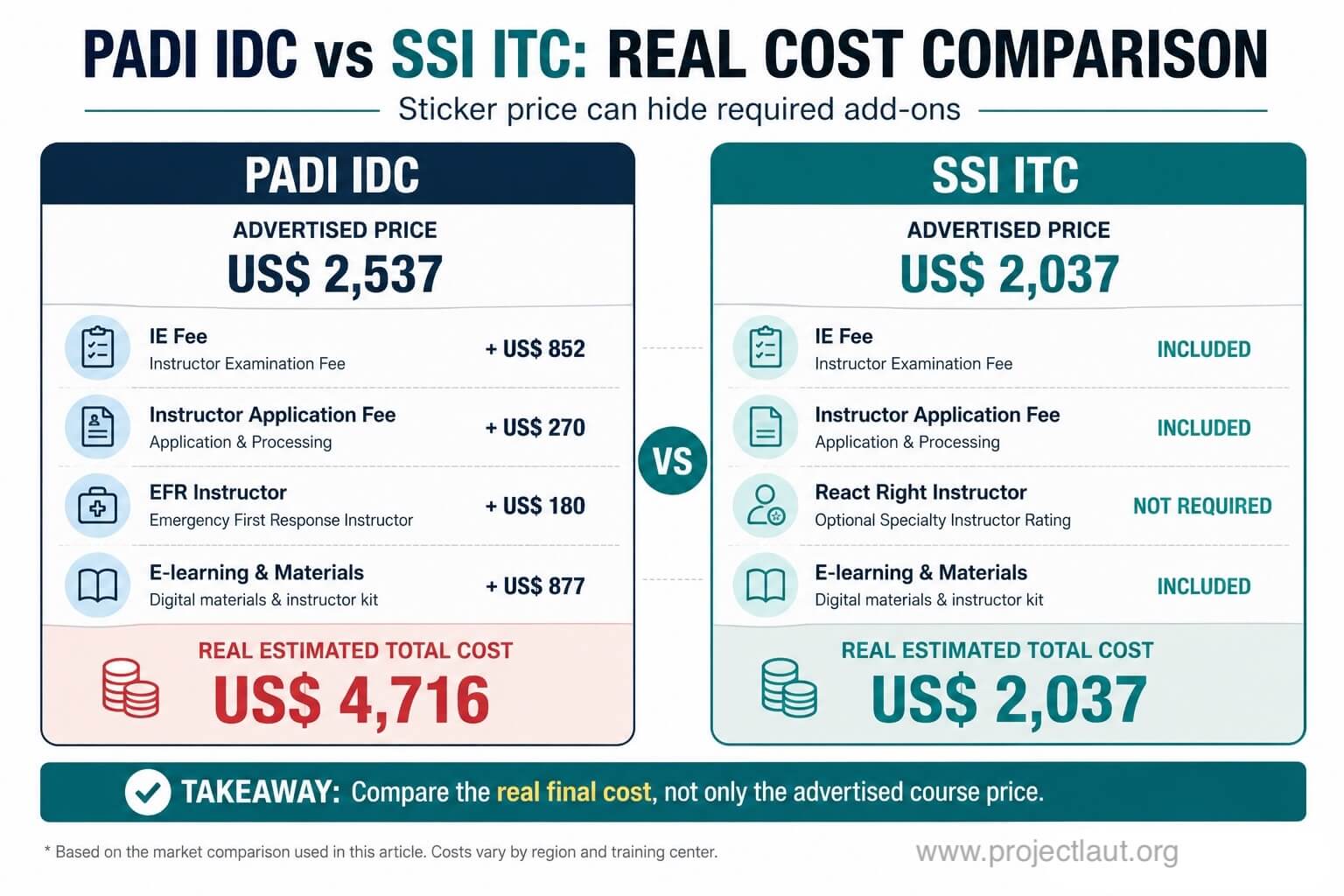
PADI IDC vs SSI ITC: Your Real Cost & Price Comparison
Comparison Point | PADI IDC | SSI ITC |
|---|---|---|
Advertised price | US$ 2,537 | US$2,037 |
IE Fee | +$852 | Included |
Instructor application fee | +$270 | Included |
EFR / React Right Instructor | +$180 | Not required |
E-learning & Instructor materials | +$877 | Included |
Total Cost | US$ 4,716 | US$ 2,037 |
* Pricing note: The PADI IDC figure above is an average based on Pro Dive Cairns, Blue Holic Scuba, and Jack’s Diving Locker. The SSI ITC figure above is an average based on Project Laut and REEFlex. All costs were converted into USD for comparison purposes using May 2026 exchange rates.
Quick takeaway: when you compare the real cost to become certified, not just the sticker price, the SSI ITC comes out substantially cheaper on average than the PADI IDC.
After all the inclusions are added, an SSI Instructor Training Course is less than half the price of a PADI Instructor Development Course.
Looking for an SSI instructor course in Bali with transparent pricing, small groups, and strong preparation for the Instructor Evaluation? Project Laut runs SSI Instructor Training Courses in Nusa Penida for candidates who want to become ready to teach, not just ready to pass.
What the Market Comparison Actually Shows
The main thing this comparison shows is not that every single PADI IDC is priced badly or that every SSI ITC is automatically superior. The point is that PADI’s headline number often fails to tell the whole story, while SSI pricing is often much closer to the real final cost.
That matters to the user. If you are budgeting for an instructor course, you care about what will leave your bank account by the time you are actually certified, not just what got put in the ad.
Why PADI Often Ends Up More Expensive
The common reasons are:
- EFR Instructor requirement
- IE fee
- Instructor application fee
- materials / supplies
- and then later, higher renewals
PADI can still be the right choice for some people. But you should go in with open eyes: it is often the more expensive route both upfront and later.
Why SSI Often Looks Better on Total Cost
SSI often looks better because:
- the IE is included in listed prices
- the digital training kit is included
- Instructor application fees are included
- there is no equivalent mandatory EFR-Instructor-style cost layered in the same way
- long-term renewals are lower
That combination makes a real difference.
Cost Note: There are still pathway-specific nuances. Someone crossing from another agency may face additional onboarding or activation costs depending on their current level. But that does not change the main comparison above: for most people asking the straightforward question “PADI IDC or SSI ITC?”, SSI usually comes out cheaper and more transparent.
Crossover Reality: Can You Do One Agency First and Switch Later?
This is another section where a lot of outdated thinking still floats around.
The old logic used to be simple: because PADI did not allow instructor-level crossovers from SSI or other agencies but SSI allowed a short 3-day instructor-level crossover from PADI, it was commonly known in the diving industry that the ideal route was to get your PADI OWSI instructor certification, and then do a “cheap” crossover to SSI. The instructors would then have certifications in the two biggest dive agencies on earth, PADI and SSI.
As of January 2025, that logic no longer applies, although many people still believe that to be the case.
Starting in January 2025, SSI closed the door for crossovers from other agencies.
SSI’s current standards for instructors and professionals from other agencies now require full participation in the SSI Instructor Training Course, as well as a full formal Instructor Evaluation. In other words, this is not some casual administrative add-on.
In practical terms, if you go from PADI to SSI now, you will need to attend a full SSI Instructor Training Course at full price.
The reverse direction is not transparent enough publicly for me to present it as a reliable discount pathway either. From my professional experience, any SSI-to-PADI discount is negligible or non-existent in practical terms. Candidates should stop planning their whole career around the idea that they will cheaply add the second agency later, and instead will have to evaluate both agencies before taking the plunge.
Key takeaway: You cannot crossover from PADI to SSI without completing a full ITC & IE
Annual Renewal, Rewards Systems & Long-Term Professional Costs
This is where a lot of instructors fail to think ahead.
Most people look at course price. Fewer people look seriously at what the professional system will cost them over the next three years. That is a mistake, because renewals and incentive structures matter a lot once you are actually working, and costs can add up quickly.
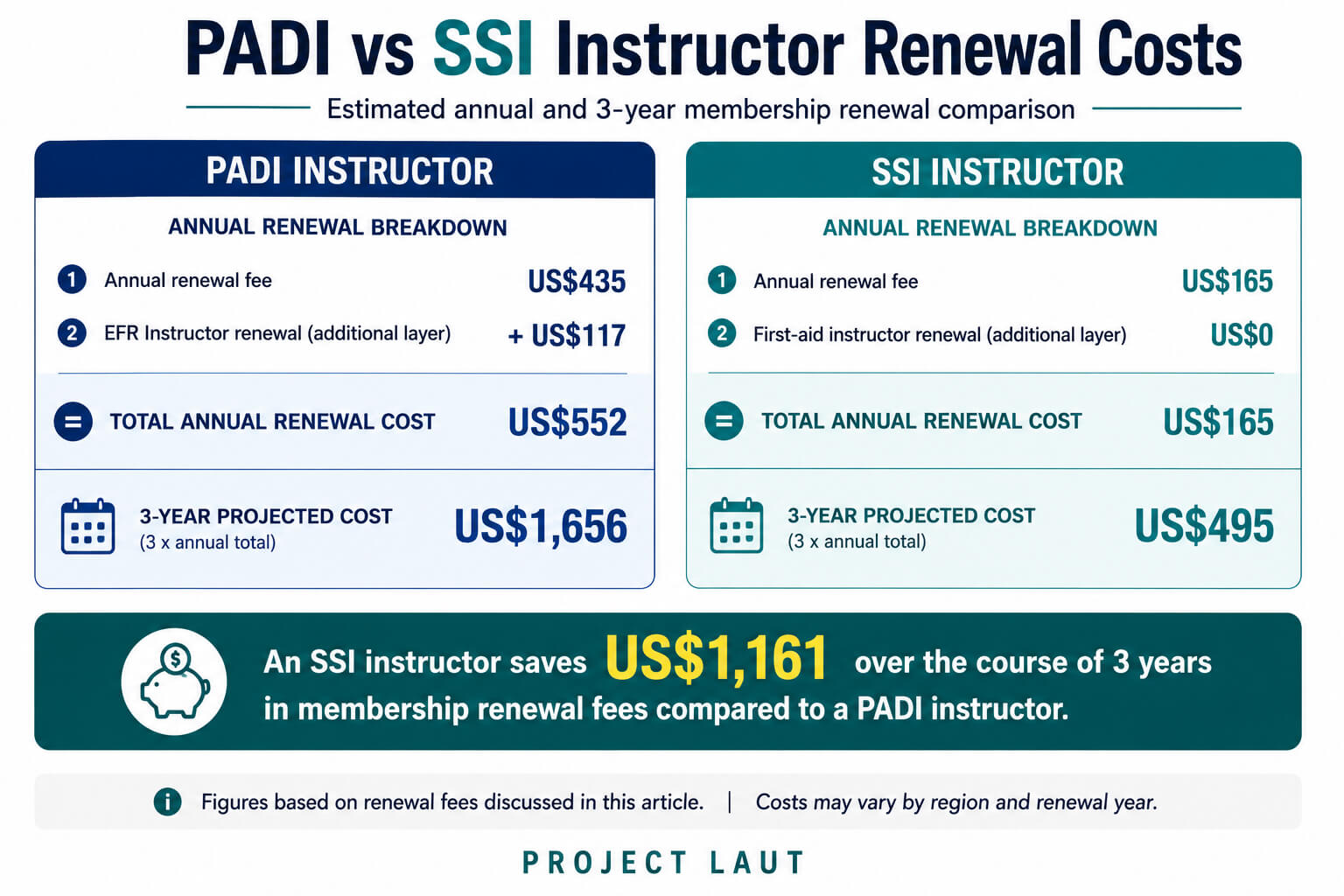
PADI vs SSI Renewal costs over time
Cost Comparison | PADI | SSI |
|---|---|---|
Approximate annual renewal charge | US$435 | US$165 |
Additional first-aid instructor renewal layer | US$117 | $0 |
Total annual renewal cost | US$552 | US$165 |
Approx. 3-year instructor renewal cost | US$1,656 | US$495 |
All annual renewal costs were sourced from this post by richcoastdiving.
What this means is that a newly certified instructor would save approximately US$1,161 over a 3-year period in renewal fees if they became an SSI instructor vs a PADI instructor. These savings are significant, and new instructors should understand the financial realities of the agency they choose to do their dive instructor course with.
These totals also do not include both agencies professional rewards programs: SSI Pro Rewards and PADI PRO+.
SSI Pro Rewards
SSI’s rewards system is better than many people realize and has been running since 2016. SSI publicly states that each Pro Reward is worth $0.10, and examples include Open Water Diver = 4 Pro Rewards and Specialty = 2 Pro Rewards. SSI materials also state that certifying a new professional earns 200 additional reward points, and rewards can be used toward renewal or purchases such as digital kits and merchandise.
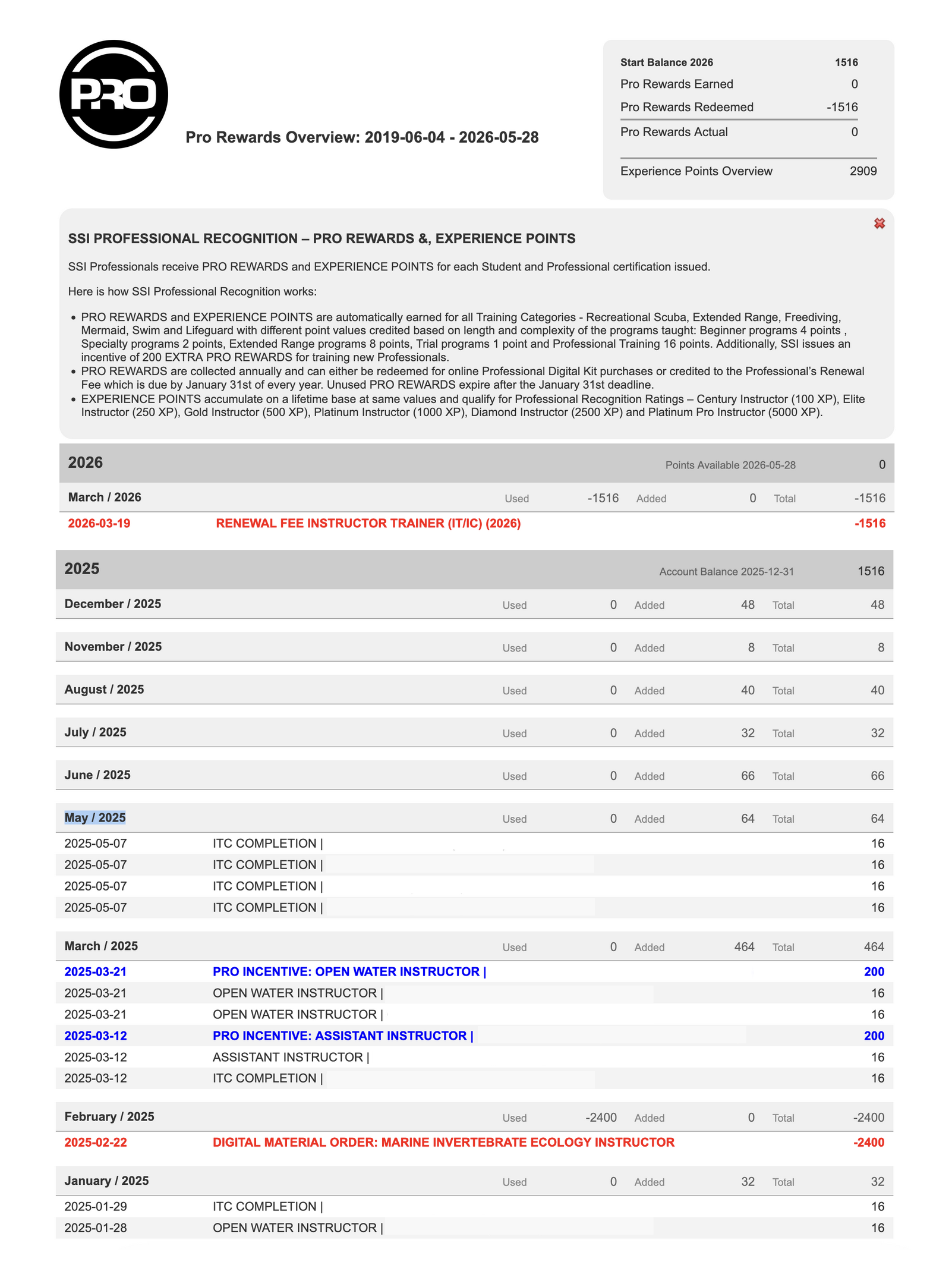
The current weighting for the SSI Pro Rewards is as follows:
- beginner programs = 4
- specialty programs = 2
- extended range programs = 8
- trial programs = 1
- professional training programs = 16
- new pros = +200 bonus
That matters because SSI does not treat every certification as basically the same. A working instructor who teaches meaningful courses, especially professional training, gets rewarded more intelligently.
SSI also gives new pros a 5x points multiplier in their first year, which makes the system far more useful when someone is just entering the industry. That is exactly when most instructors need financial help the most.
This means in your first year, for each open water certification you process you are knocking 2$ off of your annual renewal. If you have a group of 4 Open Water Students, that is nearly 8$ off of your renewal in 3 days. For an annual renewal cost of 165$, that translates to big rewards.
Another very simple example: if you certify 8 new pros in a year, the 200-point professional bonuses alone covers a full renewal.
PADI PRO+
PADI’s 2026 PRO+ Reward Program is clearly a step forward. PADI says certifications issued between 1 September 2025 and 31 August 2026 count toward rewards that can be applied as savings against future PADI Professional Membership, and the milestones include 50, 100, 150, 250, and 350 certification tiers, with 1000 points at the highest tier.
The way the system works is that at 5 certifications, you get 5 “points”. Once you get 10 certifications you get 10 “points”. The final tier of 1000 points is said to cover the full renewal cost.
The points system is as follows:
- 5 Certifications = 5 points
- 10 Certifications = 10 points
- 25 Certifications = 25 points
- 50 Certifications = 50 points
- 100 Certifications = 100 points
- 150 Certifications = 250 points
- 250 Certifications = 500 points
- 350 Certifications = 1000 points
So looking at this system, the first impression is that finally there has been improvement, and these points will be used towards cutting the high costs of PADI annual renewal fees. If you’re typical renewal cost is about US$552 per year (this changes depending on region) and 1000 points is a free renewal, then each point breaks down to roughly US$0.50!
That being said, the weighting of points is heavily tilted to the high volume tiers and does not increase linearly – so if you are an instructor producing 100 certifications in a year, this will only get you a US$50 credit on your annual renewal. However, if you are producing very high volumes of certification, then you will unlock higher tiers and have more savings.
That is real progress and a strong step in the right direction for PADI.
But the system is still much more volume-driven, and it mainly rewards high certification output and is more tightly tied to renewal savings only. SSI’s system is, in my view, more useful to the average working instructor because:
- renewals are cheaper to begin with
- certifications are weighted more intelligently
- new instructors get accelerated value in year one
- rewards can be used more flexibly
Business Direction: Where Are PADI and SSI Actually Heading?
This section does not mean agency suddenly matters more than everything else. Both agencies are valid options to pursue as an instructor, but company direction is one of several relevant details worth thinking about when you are joining a professional organization.
SSI’s story is clearer. SSI was acquired by HEAD Sports in 2014, then moved fully digital in 2015 and launched the MySSI app and digital logbook in 2016. That gives SSI a very obvious growth and modernization narrative, as HEAD is a huge international company that has many resources at it’s disposal to grow it’s presence in the dive industry. For example, HEAD Sports also owns the following companies in the dive industry / water-sport space:
- ScubaGo – A dive travel booking platform
- Liveaboard.com – The premiere liveaboard booking platform worldwide
- Mares – A dive equipment manufacturer based in Italy founded in 1949
- rEvo Rebreathers – A rebreather equipment manufacturer
- Zoggs – An australian performance swimwear equipment company founded in 1992
- Aqualung – The oldest dive equipment manufacturer in the world, founded by Jacques Cousteau in 1946 based in France
- Apeks – Well respected dive equipment manufacturer based in England founded in 1974
With these acquisitions, it is clear that HEAD is well-positioned to make big moves in the diving industry in the coming decade and has a lot of momentum behind it.
PADI has a lot of legacy momentum behind them, they are still today known as the biggest player in the diving market. We still have divers coming in everyday asking to “do their PADI” instead of calling it their Open Water Course. There is enormous success in that, brand recognition, and that is not going to change any time soon.
That being said, PADI’s recent ownership history is less convincing, and shows trends of being driven by investment & private equity firms.
In the last 14 years, PADI ownership has changed 4 times being bought and sold by various equity partners, management firms, sold for US$700 million dollars to a Canadian investment firm & French private equity firm, and then finally was sold in 2025 to an undisclosed buyer.
Taken together, that history creates a different picture from SSI under HEAD: SSI’s recent story looks more like a clear growth and modernization trajectory, while PADI’s looks more shaped by repeated ownership changes over time.
Career Outcomes: Where Are the Jobs and Which Agency Fits Best?
This is the point most people care about.
My basic rule is: choose based first on where you want to work, then compare the systems.
If you want to work in a market where PADI clearly dominates, then PADI will be the better strategic move. If you want to work in markets where SSI is equally strong or stronger, then it makes no sense to pay significantly more for an equivalent certification when pay and career outlooks are identical.
These regional patterns are best understood as professional industry observations, not hard official map data.
Regional fit at a glance
For most instructor candidates, the smartest way to compare agency fit is to start with geography: where do you want to work, whether the work is year-round or seasonal, and what realistic earning potential looks like in each market.
Region | Working Pattern | High Season | 2026 Pay Band (USD/month) | Notes |
|---|---|---|---|---|
Thailand | Year-round | Nov – May | $1,100 – $1,400 | SSI dominant market. |
Indonesia | Year-round | Apr – Oct | $850 – $1,150 | Mixed-agency market. |
Philippines | Year-round | Nov – May | $850 – $1,150 | Mixed-agency market. |
Australia | Year-round | Region dependent | $2,260 – $2,900 | PADI dominant market. |
Europe / Mediterranean | Strongly seasonal | May – Oct | $2,260 – $2,900 | SSI dominant market. |
Caribbean / Central America | Long season / semi year-round | Dec – Apr | $800 – $1,200 | PADI dominant market. |
Liveaboards | Route dependent | Route dependent | $3,000 – $5,000 | Mixed-agency market |
Pay note: Most dive instructor roles are built around a base salary plus commissions, so the monthly earnings shown above usually reflect active working months. In low season, take-home pay can be significantly lower.
Decision Checklist: Which Instructor Agency Fits Your Goals?
Ask yourself if… | If yes… | What that means |
|---|---|---|
Do I want the biggest legacy brand? | Yes | Go with PADI |
Do I want the lowest total cost? | Yes | Go with SSI |
Do I care a lot about lower renewals? | Yes | Go with SSI |
Do I want a more modern digital system? | Yes | Go with SSI |
Do I prefer a more fixed framework? | Yes | Go with PADI |
Do I want more teaching flexibility? | Yes | Go with SSI |
Do I want to work in Southeast Asia & Europe? | Yes | Go with SSI or PADI |
Do I want to work in Australia or the Caribbean? | Yes | Go with PADI |
Am I thinking of doing my PADI IDC then crossing over cheaply to SSI? | Yes | Re-think that plan, it is no longer possible |
Do I care more about trainer quality than logo alone? | Yes | Good – that is the right mindset! |
Bottom Line Cheat Sheet
PADI = Strong legacy brand, high market recognition, still a great option in most markets, but usually more expensive, less transparent, and more rigid in style and function.
SSI = More affordable, modern, flexible, digitally supportive, and often better long term value
Both are valid routes for new instructor candidates, and the PADI vs SSI debate essentially comes down to a couple of factors:
- Where you want to work
- What you can afford to spend on an instructor course
- If you care about long-term renewal costs
- What kind of teaching system you want to operate in
- What professional ecosystem you want to join
Final Note: This article is an independent comparison based on publicly available materials, current standards where accessible, and professional industry experience. It is not affiliated with or endorsed by PADI, SSI, or any other dive agency. All costs and figures are sourced from online sources and averaged where applicable to create a more broad and accurate comparison. All facts, figures, and conversions are accurate to May 20th, 2026.

How to Enroll with Project Laut
If you are comparing your options and want an SSI Dive Instructor Course in Bali with:
- transparent pricing
- no hidden-fee trap
- small groups
- strong preparation
- and a serious focus on actually becoming ready to teach,
then look at our Instructor Training and Fast Track to Teach pathway.
FAQs – PADI vs SSI Instructor Course
Is PADI or SSI better for becoming a dive instructor?
Neither is universally better. Both are valid. The better route depends on where you want to work, what system fits you better, and what total cost and renewal burden you are willing to accept.
Is SSI easier than PADI at instructor level?
That is the wrong comparison. Both are demanding. The more important variable is how well the center and trainer prepare you.
Which instructor course is cheaper PADI or SSI?
In the market comparison used in this article, the SSI ITC came out substantially cheaper on average once real final costs were compared. The price of an average SSI ITC was less than 50% the cost of a full PADI IDC after all the hidden costs were added on.
Does PADI still have better job prospects?
In some markets, yes. In others, no. That is exactly why region should be your first filter.
Can you get a job as an SSI Instructor?
Yes – SSI is one of the largest dive training organizations in the world with over 4,000 training centers. In any diving region you can find SSI training centers, and in certain areas such as Southeast Asia and Europe SSI has the strongest industry presence.
Can I do my PADI IDC then crossover to SSI after?
No, there are no more quick and affordable crossover options from PADI to SSI. Now if you do your PADI IDC and want to get your SSI Instructor rating you will have to participate in a full SSI Instructor Training Course.
What is the difference between a PADI IDC and an SSI ITC?
Broadly speaking, not as much as people assume. Both instructor courses include Assistant Instructor-level progression, Open Water Instructor-level development, and a final IE (instructor exam) portion.
Do PADI instructors get a discount to crossover into SSI?
No, PADI instructors do not get a discount to crossover to SSI.
Is React Right Instructor required to become an SSI instructor?
No, it is not required to get your SSI React Right Specialty Instructor rating to become an SSI Instructor. It is treated as a separate optional specialty rating that you can earn later on.
How does the SSI Pro Reward points work?
SSI rewards certification activity with points that can be used toward renewals and other professional purchases. The system is weighted by course type and gives new instructors a strong 5x points boost in the first year.
How does the PADI PRO+ Rewards system work?
The PADI PRO+ rewards system works by awarding instructors points when they hit certification targets. The type of certification doesn’t matter, all certifications are weighted evenly, and points can only be used towards renewal fees. PADI states once instructors hit the 300 certification mark, their renewal will be free.